
Last year, the introduction of the XRPL’s Multi-Purpose Token (MPT) standard marked a key shift for the blockchain world, offering a compliance-focused, institutional-grade framework for tokenizing real-world assets (RWAs). The conversation has since evolved rapidly from “What can MPTs do?” to “Look what’s now being built with them.”
Core to this is the XRPL’s robust native tokenization framework, which seeks to represent any asset, from financial instruments to physical goods, on blockchains with precision and compliance-features. While the XRPL’s tokenization framework provides a practical guide on how to create MPTs, a new whitepaper has just been published as well.
In this piece, I’ll be highlighting three projects built in line with the XRPL’s framework:
- LiCuido: Using MPTs to represent shares in money market funds, enabling them to be used as instant, programmable collateral for institutional lending.
- Centigrade: Using MPTs to embed rich environmental data into carbon credits, creating a transparent and auditable market for carbon credits.
- Fortstock: Using MPTs to digitize warehouse receipts into on-chain collateral, unlocking liquidity for small businesses by leveraging their real-world inventory.
I’ll cover each project in-depth, including the specific use cases they are a) building, b) their specific integration of the MPT standard, c) their decision to choose the XRPL over other blockchain networks, and d) a brief description of devnet testing.
P.S. If you are interested in building on the XRPL, ping me on Telegram. It’s fast.
Multi-Purpose Tokens
It’s first worthwhile to quickly recap Multi-Purpose Tokens (MPTs) as they represent a fundamental evolution in how we tokenize real-world value.
MPTs are an XRPL-native token standard that blends the properties of two familiar types of tokens:
- Fungible tokens, which are identical and interchangeable, such as XRP or RLUSD.
- Non-fungible tokens (NFTs), represent unique assets such as art or tickets.
The result is a new class of “semi-fungible” tokens that can have metadata attached, giving them the ability to represent a wide variety of complex assets such as financial instruments, carbon credits, real estate deeds, or even physical commodities like gold bars. For instance, a financial instrument could have details such as the issuer’s identity, coupon rate, maturity date, and more encoded directly into its on-chain metadata.
Many developers focused on tokenization are now choosing MPTs for a few key reasons:
- Shared Traits: MPTs can represent classes of items (such as bonds) that have shared traits but unique instances, such as expiry dates.
- Stored Metadata: Unlike NFTs, MPTs can store comprehensive asset-specific information directly on-chain, while also referencing off-chain data such as legal documentation held by financial institutions.
- Flexibility: MPTs can be extensively adapted to suit various use cases, including complex token structures, custom token supplies, custom fees (e.g. transfer fees), and more.
Though potentially most important, are the extensive institutional-grade compliance-focused features that make it easy for businesses to launch safely and securely on the XRPL. A few of these critical safeguards include:
- Clawback & Global Freeze: Capability to revoke, re-assign tokens, or freeze MPT balances in exceptional circumstances. I covered the Clawback & Global Freeze in-depth here.
- Authorization: Essentially an “allowlist” where issuers can determine who is allowed to hold a token, like a qualified investor.
- Non-Transferable Tokens: Ability to restrict token transfers except to the issuer’s wallet, enhancing control over token movements.
With that covered, let’s now dive into the three projects.
LiCuido
Website: https://www.licuido.io/
LiCuido is tackling a long-standing pain point in traditional finance: the hidden fragility of money market funds (MMFs).
MMFs are financial funds that hold short-term, high-quality assets such as U.S. Treasuries. They’re the backbone of institutional cash management, but when markets get stressed (think: March 2020 or September 2008), everyone rushes to redeem at once, which forces funds to liquidate dozens of underlying assets and creates a system-wide liquidity crunch.
How LiCuido Leverages MPTs
LiCuido’s answer is to tokenize MMF shares on the XRPL using the MPT standard. This provides new utilities:
- Instant Collateral: Tokenized shares can be instantly pledged as collateral to meet margin calls with clearinghouses or counterparties, eliminating the need to liquidate underlying holdings during market stress. This prevents forced selling, avoids losses, and reduces systemic risk.
- Repo-Ready Liquidity: These digital shares become instantly usable as collateral in the $20 trillion repurchase agreement (repo) market, allowing institutions to raise short-term cash by securing loans against their tokenized assets.
- Programmable Compliance Controls: The MPT standard enables built-in, hard-coded rules such as fixed supply caps, controlled transfer restrictions (e.g., tokens are only redeemable back to the issuer), and detailed whitelisting to ensure only pre-approved, institutional wallets can hold or trade the tokens.
For instance, imagine a large asset manager facing a sudden margin call. Traditionally, they would be forced to rapidly sell off holdings, potentially at a loss, exacerbating a market downturn. With LiCuido, they can instead instantly transfer tokenized MMF shares from their wallet to their prime broker’s wallet as collateral. This transaction settles in seconds, satisfies the margin requirement without requiring a single trade, and allows the manager to maintain their investment position.
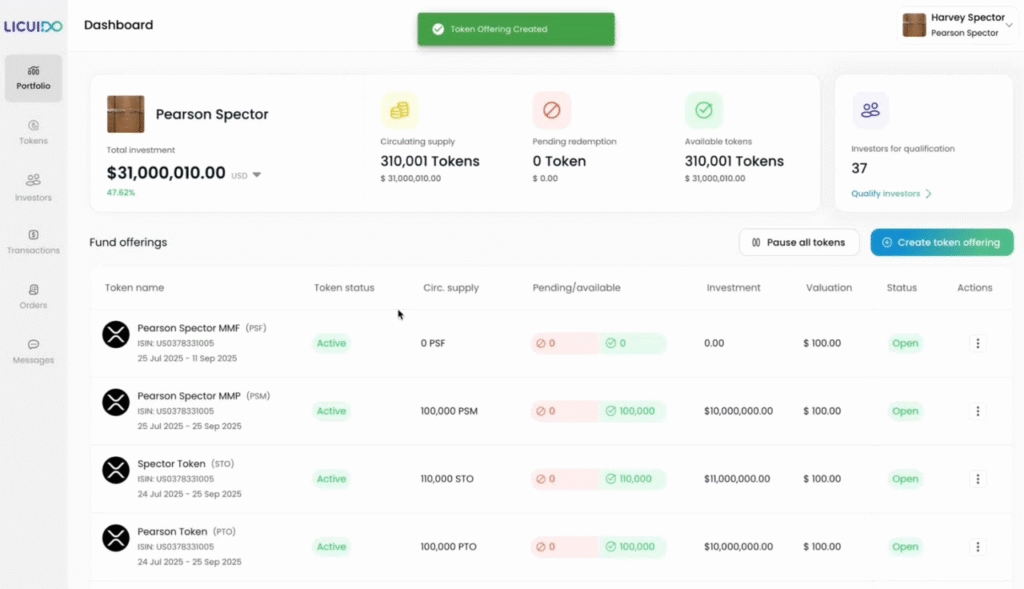
LiCuido’s Dashboard: Shows a live tokenized money-market fund offering, with circulating supply, investor qualifications, and real-time investment and redemption data managed on the XRPL.
Why LiCuido Chose the XRPL
The LiCuido team consulted various leading blockchain networks but ultimately selected the XRP Ledger for reasons that resonate with risk-averse institutions.
“Security was by far the biggest thing,” CEO Brian Lynch noted. The XRPL’s proven, 10+ year track record of consistent uptime and zero exploits was paramount, as well as the various institutional-grade security features, such as the Clawback Feature.
Their initial phase will utilize traditional fiat settlements first to demonstrate the significant utility of tokenized collateral. The strategic endgame, however, is atomic settlement using digital assets like Ripple’s RLUSD. This would enable instantaneous repo transactions, eliminating the counterparty credit risk that plagues the ~$20 trillion repo market and presenting a monumental leap in efficiency.
LiCuido has already minted and transferred prototype money-market-fund tokens on the XRPL Devnet, confirming that MPTs can carry the compliance rules, whitelist controls, and collateral-transfer logic needed for institutional use.
Centigrade
Website: https://centigrade.earth/
Centigrade is an on-chain data and validation platform for carbon credits, which represent digital proof that one ton of CO₂ has been removed from or kept out of the atmosphere.
Carbon markets are massive but messy: credits are intangible, verification is slow, and trust is shaky. Prices vary wildly by project type and vintage, and double-counting scandals have scared off many buyers. Centigrade’s platform allows project developers to submit data following industry-standard methodologies and undergo third-party verification, quickly creating a transparent and auditable record.
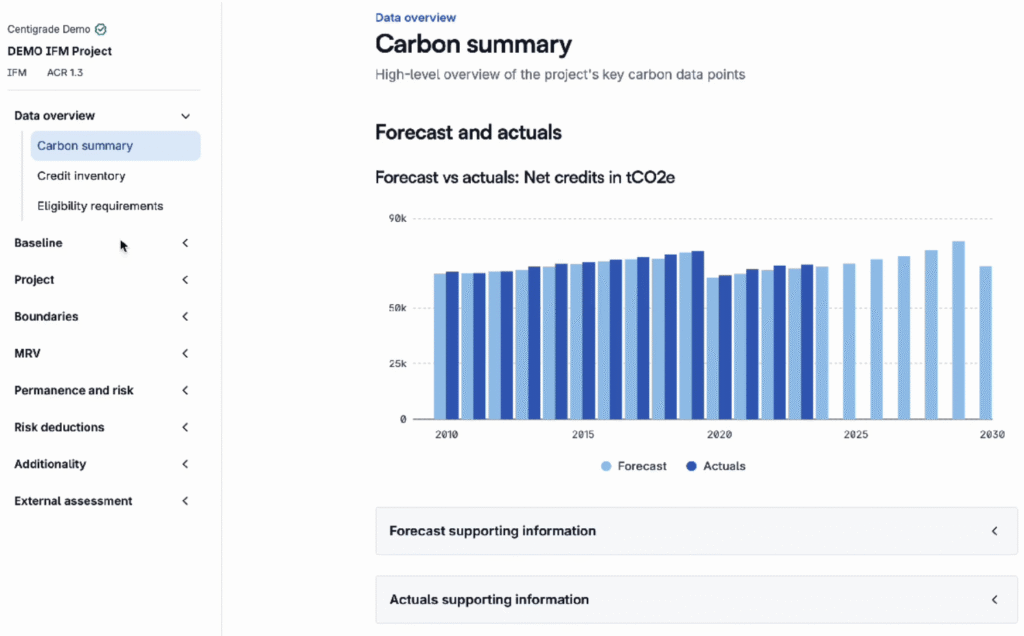
Centigrade’s Dashboard: Shows a carbon project’s forecasted versus actual net CO₂ credits over time, providing a transparent, auditable record of emission reductions.
How Centigrade Leverages MPTs
Centigrade is using MPTs in several key ways:
- Fast Settlement: Today’s over-the-counter carbon credit trades are manual and often take days to settle. Tokenization enables instant, peer-to-peer settlement on a global market that’s open 24/7.
- Granular pricing by project: Each credit can carry project metadata, such as the carbon pricing methodology, year, location, etc. This means the market can quickly price credits differently, and there’s no need for external smart contracts.
- Verifiability: Blockchain’s traceability prevents double-counting. Various contracts (such as forward contracts) can also be minted as non-transferable tokens (sometimes referred to as “soulbound” tokens in other blockchains) tied to the original buyer, preventing secondary trading.
- Compliance: XRPL’s compliance features like Clawback, mean that if a project fails verification, the issuer can revoke the tokens, protecting buyers and maintaining market integrity.
For instance, a third-party verifier, using drone footage and sensor data, would first certify a reforestation project’s carbon capture on Centigrade’s platform. Once verified, credits are minted as MPTs with this proof embedded in their metadata. A corporation can then purchase and retire these tokens, with the Clawback feature serving as a final safeguard to revoke the token if the underlying verification is ever proven fraudulent.
The platform is already live and supporting many different projects, ranging from Direct Air Capture in Kenya to large-scale forest conservation led by Indigenous communities.
Why Centigrade Chose the XRPL
The team evaluated various blockchain networks but ultimately chose the XRPL for two reasons:
- Compliance capabilities: Features such as KYC identification and Clawback, which are non-negotiable for enterprise clients.
- Sustainability: Alignment with XRPL’s sustainability and the enterprise-ready nature of the ecosystem resonated with their target clients.
To date, Centigrade has successfully tested the core functionality of minting and managing tokenized carbon credits on the XRPL Devnet. They’ve also partnered with multiple carbon-offset projects and verification bodies, such as the American Carbon Registry and Gold Standard, to bring high-integrity credits on-chain. The next step is to move from successful devnet tests to live operations, scaling a model that finally brings trust and efficiency to the carbon markets.
Centigrade is an excellent example of a creative application of tokenization, bringing transparency and efficiency to the complex carbon markets. It’s also a powerful blueprint for how any industry built on trust and verification can be reimagined on-chain with the proper infrastructure in place.
Fortstock
Website: https://fortstock.io/
Fortstock is a company using MPTs to represent traditional warehouse receipts as on-chain financial instruments.
Warehouse receipts are official documents issued by storage facilities to certify details such as the specific quantity of goods held, their ownership, and value. They not only describe goods, it but also represent the legal title or claim to them, making them valuable as collateral.
Global trade moves over $25 trillion in goods annually, yet a massive amount of this inventory (across both small and mid-sized enterprises (SMEs) and large trade companies) sits financially idle, unable to be leveraged as collateral. This creates a multi-trillion-dollar gap in trade finance and leaves capital trapped across the supply chain.
How Fortstock Leverages MPTs
By tokenizing warehouse receipts, Fortstock turns static inventory into liquid capital. This approach highlights why MPTs are such a natural fit for Fortstock’s mission. By embedding legally relevant metadata (like warrant numbers, expiry dates, or hashes of the original receipt) directly into the token object, the XRP Ledger lets each warehouse-receipt token track its entire lifecycle from issuance to collateralization to final burn.
This enables:
- Unlocked Liquidity: Idle inventory becomes liquid on-chain collateral, allowing businesses to borrow against their stored goods almost instantly, rather than waiting for traditional loan approval. At the same time, lenders earn 8–12% yields backed by physical goods.
- Global Scalability & Compliance: A cross-border, 24/7 solution with built-in features like the XRPL Clawback and Freezing.
- Metadata: Extensive data, such as the commodity type, quantity, location, expiry dates, and warranty numbers, can all be put as metadata using MPTs.
- Data Provenance: Every transaction is recorded on-chain, providing a permanent and transparent chain of custody that reduces fraud and legal disputes while streamlining audits.
For example, a coffee exporter in Colombia could use tokenized $1M worth of warehouse receipts representing stored green coffee beans, using these tokenized receipts as collateral to secure an instant loan from a lender in Singapore. They could then fund their next shipment without selling their current inventory at a discount.
Fortstock’s MVP is fully built and ready for commercial rollout, with the first major warehouse onboarding and initial loan issuance planned for Q4 2025. The company has already established partnerships with major commodity facilities affiliated with the London Metal Exchange, signaling strong demand across the broader warehousing market.
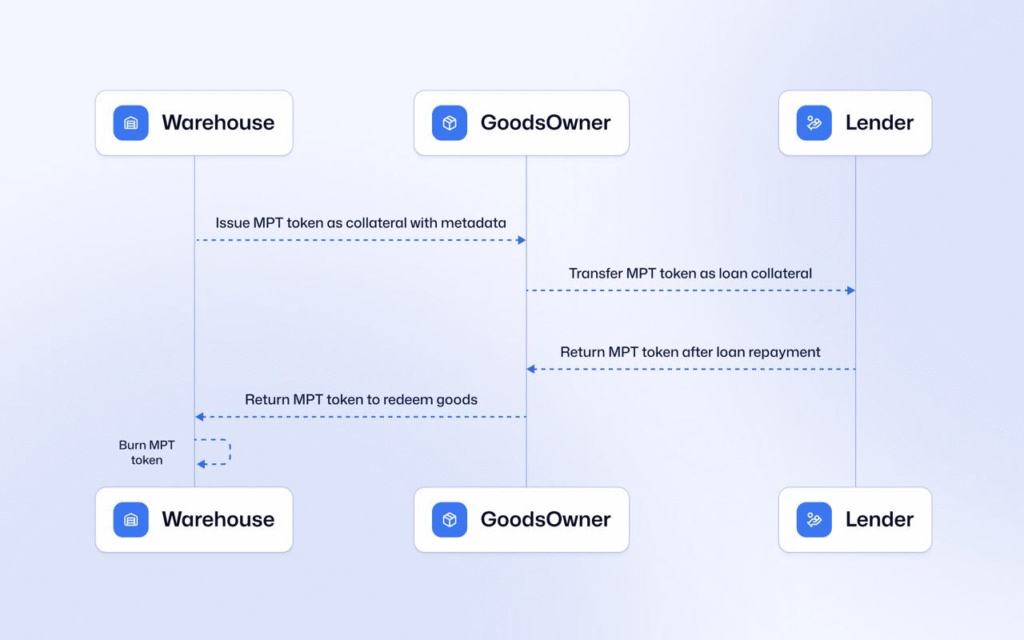
Fortstock Flow Visualized: A warehouse issues an MPT token representing the stored goods, the goods owner transfers that token to a lender as loan collateral, and the lender returns it once the loan is repaid. The goods owner then redeems the token with the warehouse, which burns it.
Why Fortstock Chose the XRPL
Fortstock spoke with various blockchain networks but ultimately chose the XRPL because of two key differentiators:
- The native MPT standard: MPTs allow Fortstock to manage the full asset lifecycle (e.g., from issuance to loan repayment) within the token’s inherent properties, eliminating the need for complex, risky, and expensive external smart contracts. All business logic is embedded directly into the token itself.
- Institutional-grade compliance features: Features like Clawback and Freezing are essential for a regulated financial environment, providing the safety nets needed to manage defaults, resolve disputes, or correct errors, giving both warehouse operators and lending institutions the confidence to participate.
Having successfully demonstrated core functionality on the XRPL Devnet, Fortstock’s immediate next steps involve onboarding its first major warehouse partners and regulated lending institutions to issue live loans. By building on the XRPL’s compliance-forward, high-speed base layer, the project is now poised to scale a global model that brings programmable finance to real-world assets.
What’s Next For The XRPL?
The three projects highlighted here illustrate how the XRPL’s Multi-Purpose Token standard is already reshaping real-world finance. Each tackles a different market gap, yet all rely on the same technological foundation: a fast, low-cost ledger with compliance baked into its core.
The tokenization framework unlocks trillions in real-world value and sets the stage for the next wave of on-chain finance, with an upcoming whitepaper to be shared here (follow here for live updates).
The MPT standard represents the next evolution of XRPL’s tokenization capabilities—battle-tested at the protocol level and already proven in live pilots. Early builders with strong ideas are uniquely positioned to define this new phase of programmable finance and capture outsized opportunities as adoption accelerates.
As more builders recognize these advantages, expect a surge of MPT-based solutions across industries far beyond warehousing, carbon credits, and money markets: think supply-chain finance, real-estate deeds, loyalty programs, and regulated stablecoins. The XRPL’s combination of institutional safeguards, on-chain metadata, and near-instant settlement provides the infrastructure these applications need to scale globally without sacrificing security or regulatory clarity.
If you’re exploring a tokenized product of your own, now is the time to start. Ping me on Telegram with a short note about your idea, and I can help connect you to the right XRPL contacts to bring it to life.